


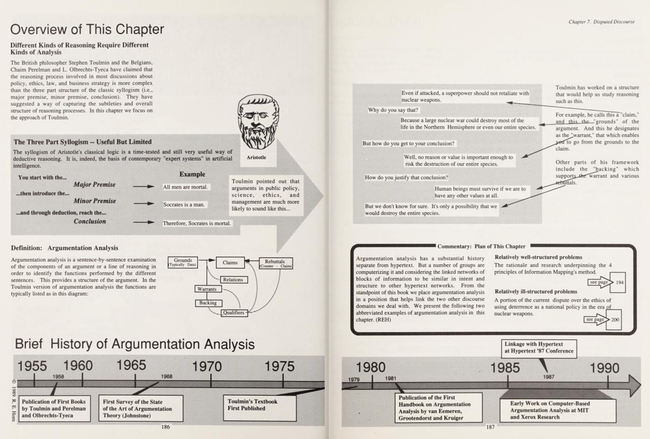
The British philosopher Stephen Toulmin and the Belgians, Chaim Perelman and L. Olbrechts-Tyeca have claimed that the reasoning process involved in most discussions about policy, ethics, law, and business strategy is more complex than the three part structure of the classic syllogism (i.e., major premise, minor premise, conclusion). They have suggested a way of capturing the subtleties and overall structure of reasoning processes. In this chapter we focus on the approach of Toulmin.
…
Argumentation analysis has a substantial history separate from hypertext. But a number of groups are computerizing it and considering the linked networks of blocks of information to be similar in intent and structure to other hypertext networks. From the standpoint of this book we place argumentation analysis in a position that helps link the two other discourse domains we deal with. We present the following two abbreviated examples of argumentation analysis in this chapter. (REH)
Relatively well-structured problems
The rationale and research underpinning the 4 principles of Information Mapping's method.
see page 194
Relatively ill-structured problems
A portion of the current dispute over the ethics of using deterrence as a national policy in the era of nuclear weapons.
see page 200
Do you like what you are reading? Subscribe to receive updates.
Unsubscribe anytime